Categories
News

A Strong Start, a Hard Second Day, and a Week Worth Building On

Partnership Announcement

A Strong Start, a Hard Second Day, and a Week Worth Building On

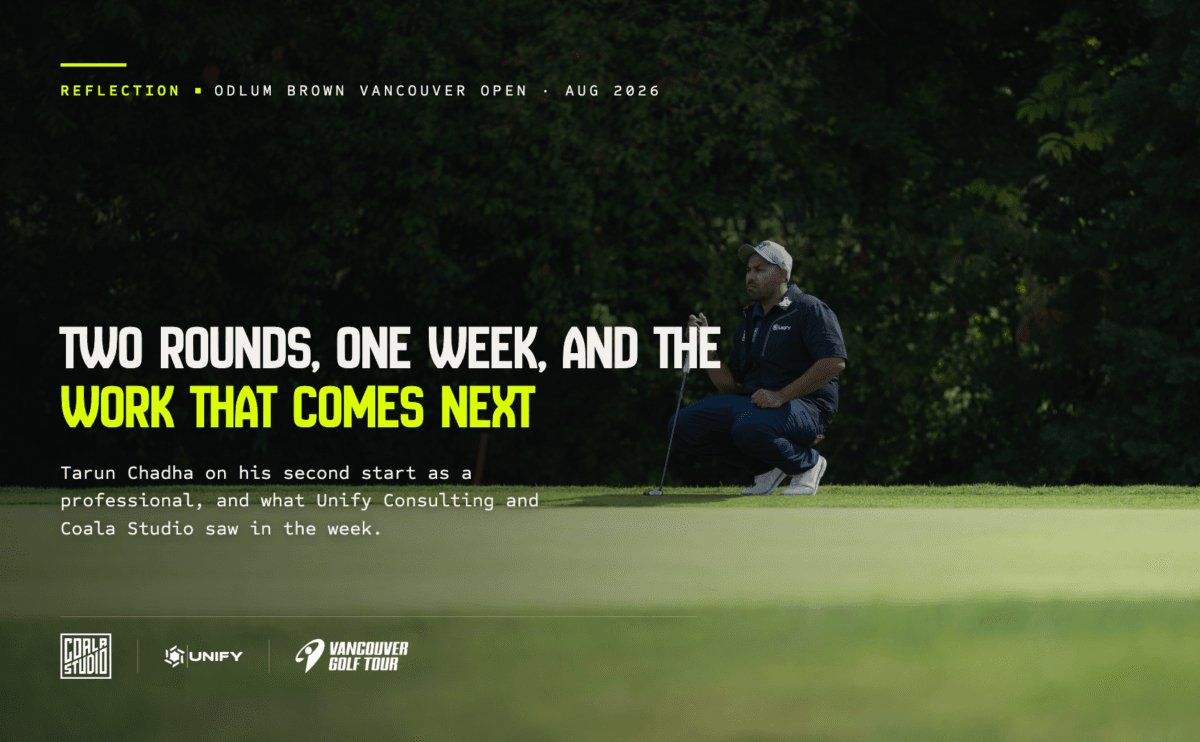
Tarun Chadha's Vancouver Open ended after two rounds. The partnership behind him didn't.

Vancouver, B.C.

September 1, 2026

3 min read

Day 1 · Vancouver Golf Tour
Debut
Wed, Sep 1
Event
Odlum Brown Vancouver Open
Venues
McCleery · Langara · Fraserview
Field
300+ Players, 54 Holes

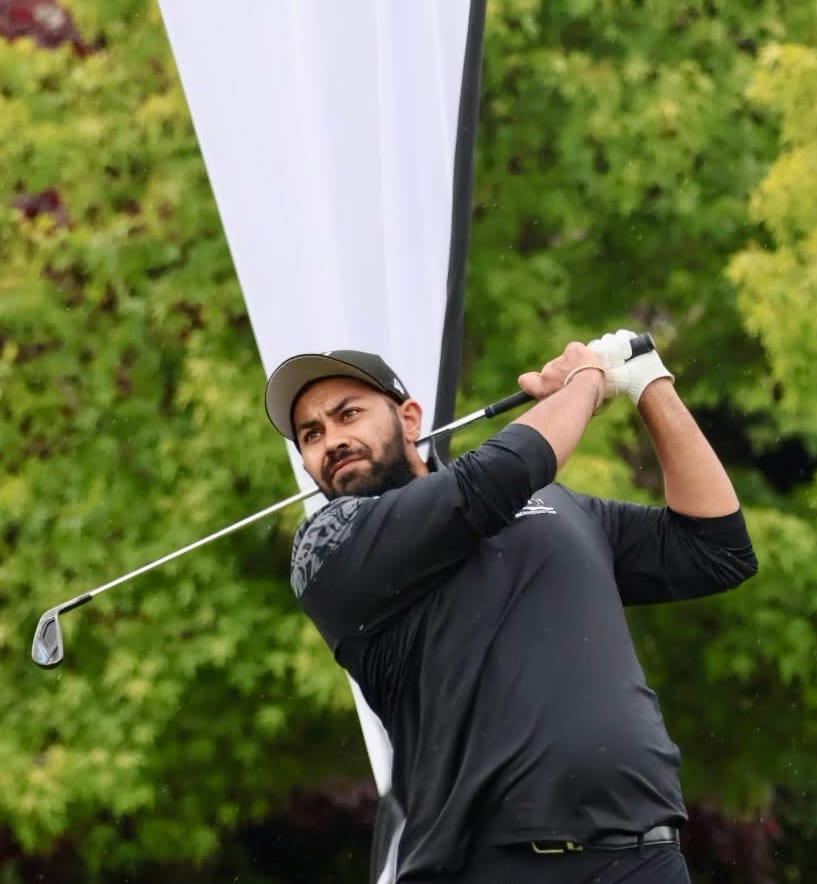
Tarun Chadha’s week at the Odlum Brown Vancouver Open ended after 36 holes. He opened with a one-under 70 at McCleery on Friday, followed with a 77 on Saturday, and finished at 147 for the championship, tied for 55th and outside the cut.

It was his second start as a professional, and the first two competitive rounds wearing the Coala Studio and Unify Consulting marks.

The first day was everything he could have asked for. Chadha made 14 pars, three birdies and two bogeys at McCleery, never worse than a bogey across 18 holes, with birdies at the ninth, tenth and twelfth taking him to three under through 12 before he closed with five straight pars. It left him tied for 26th and comfortably in the mix.

Saturday didn’t follow. In a 54-hole championship there is very little room to absorb a round that gets away, and the second-round 77 was enough to end his week a day early.

"Vancouver Open 2026 was a great learning experience for me, For my second start as a professional, I played well on the first day, but unfortunately couldn't carry that momentum into the second round. While I'm disappointed with the result, I'm taking the positives from the week and using it as an opportunity to grow and improve."

"I'm grateful to Unify Consulting and Coala Studio for believing in me and supporting me through this opportunity. Moving forward, my mindset is to trust the work I've put in, stay patient, and focus on the process. I know I have the game to compete, and I'm excited to keep improving and come back stronger for the next tournament."

Both sponsors were on the course during the week, and neither read the result as a verdict.

"When we backed Tarun, we backed the effort and the mindset — not a result, We're believers in process. Results follow process, not the other way around. Tarun's process is sound, and he'll come back strong for the next one. On to the next."

other way around. Tarun’s process is sound, and he’ll come back strong for the next one. On to the next.”

Jimmy Hansra, Principal Consultant at Unify Consulting and a former captain of Canada’s national cricket team, has been on the other side of weeks like this one.

It was great to see Tarun out there, and he had a genuinely strong start on day one," Hansra said. "Day two didn't fall his way, but that's golf, and that's sport. You move on, and you come back stronger.

The front-of-shirt partnership runs through Chadha’s 2026 Vancouver Golf Tour season. He turned professional in July after four seasons competing on the VGT as an amateur, and made his professional debut at the Cultus Open later that month.

There will be more starts this season. The week produced a round he can build on, a round he’ll want back, and a reminder of what separates the two — which, two starts into a professional career, is roughly what it was supposed to produce.

At a Glance

Athlete
Tarun Chadha
Sponsors
Unify Consulting & Coala Studio
Deal Type
Front-of-shirt sponsorship
Season
2026 Vancouver Golf Tour
Debut Wearing Marks
Aug 28, 2026 — Odlum Brown Vancouver Open
Pro Debut
July 2026, Cultus Open

Media Contact

For interviews, imagery, or additional comment on this partnership, reach the Coala Studio team directly.

info@coalastudio.ca

(236) 333-1693

Categories
News

Round One — Tarun Chadha Opens With 70 at McCleery

Partnership Announcement

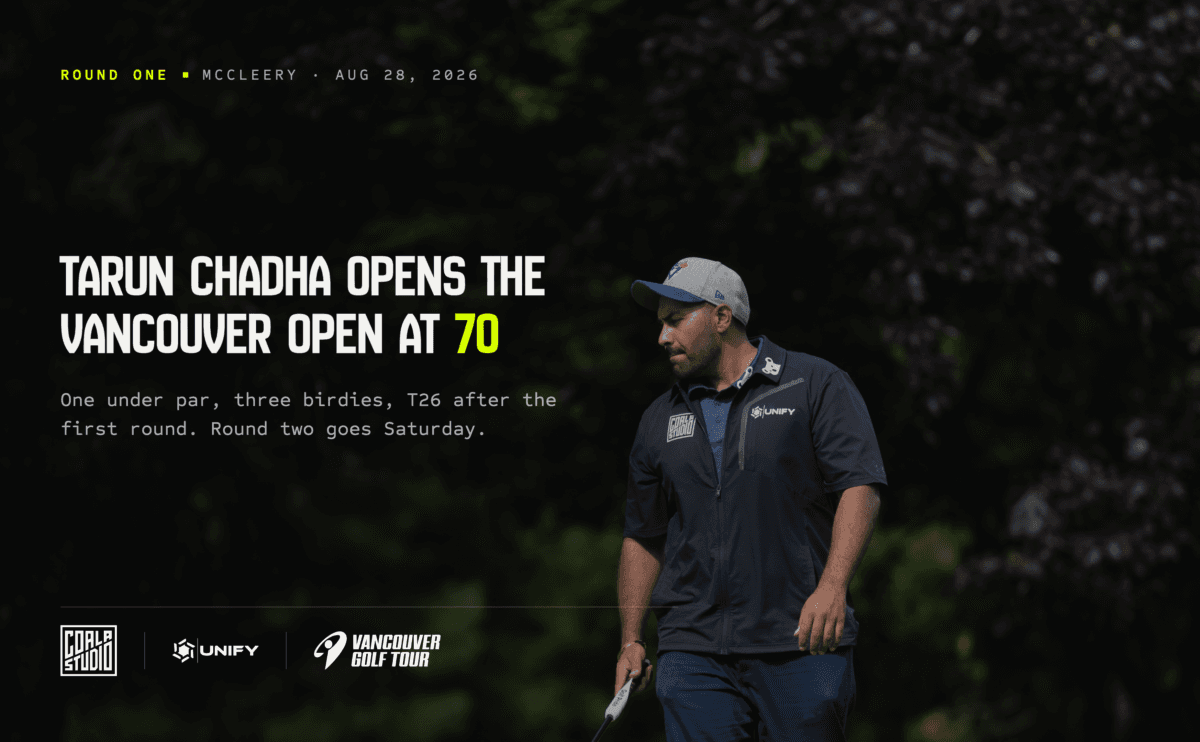
Chadha Opens Vancouver Open With Bogey-Free Back Nine Charge, Sits T26 After Round One

A one-under 70 at McCleery on debut for the Coala Studio and Unify Consulting shirt.

Vancouver, B.C.

August 26, 2026

3 min read

Day 1 · Vancouver Golf Tour
Debut
Fri, Aug 28
Event
Odlum Brown Vancouver Open
Venues
McCleery · Langara · Fraserview
Field
300+ Players, 54 Holes

Tarun Chadha opened the Odlum Brown Vancouver Open with a one-under 70 at McCleery Public Golf Course on Friday, leaving him tied for 26th after the first of three rounds.

It was the first time he had worn the Coala Studio and Unify Consulting marks in competition, following the front-of-shirt partnership announced earlier this week.

The round was built on patience rather than fireworks. Chadha made 14 pars, three birdies and two bogeys, and never made worse than a bogey across 18 holes — the kind of scorecard that rarely gets talked about and almost always keeps a player in a tournament.

He turned in even-par 35, having given a shot back at the par-three third and picked it up again with a birdie at the ninth. The best stretch of his day came immediately after: birdies at the ninth, tenth and twelfth put him three-under through 12 and moved him up the board. A bogey at the 13th checked the run, and he closed with five consecutive pars to sign for 70.

"I played some good golf today and I feel pretty confident going into day two,” Chadha said. “A few putts could have gone my way. It was boring golf in a way — but I'm happy with the round."

He turned professional in July after four seasons competing on the Vancouver Golf Tour as an amateur, and this is his second start as a pro following his debut at the Cultus Open.

For his backers, the first day delivered more than a number.

Watching Tarun play today was something else,” said Rounak Sardesai, founder of Coala Studio. “Seeing our name on a pro's shirt at a VGT event was an emotional moment for me. And for him to play the way he did on top of that — I couldn't have asked for more.

Jimmy Hansra, Principal Consultant at Unify Consulting and a former captain of Canada’s national cricket team, watched the round from the course.

Tarun's story is one I've been excited about from the start,” Hansra said. “Watching him hit some of the shots he did today made it clear the effort he puts in is paying off. He's in a competitive position going into the second round, and I wish him the very best

The championship continues Saturday, with the final round at Fraserview on Sunday.

At a Glance

Athlete
Tarun Chadha
Sponsors
Unify Consulting & Coala Studio
Deal Type
Front-of-shirt sponsorship
Season
2026 Vancouver Golf Tour
Debut Wearing Marks
Aug 28, 2026 — Odlum Brown Vancouver Open
Pro Debut
July 2026, Cultus Open

Media Contact

For interviews, imagery, or additional comment on this partnership, reach the Coala Studio team directly.

info@coalastudio.ca

(236) 333-1693

Categories
News

Unify & Coala Studio Sponsor Golfer Tarun Chadha

Partnership Announcement

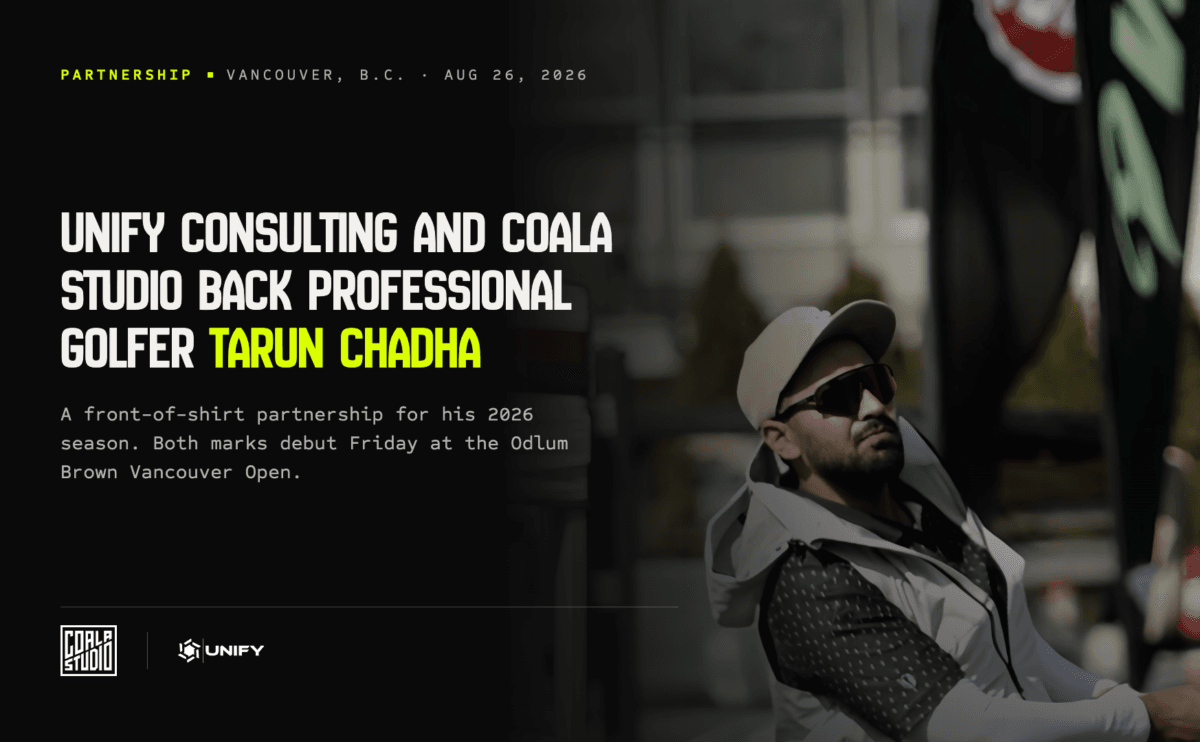
Unify Consulting & Coala Studio back Tarun Chadha in front-of-shirt deal

The newly turned professional wears both marks for the first time this Friday at the Odlum Brown Vancouver Open.

Vancouver, B.C. August 26, 2026 3 min read
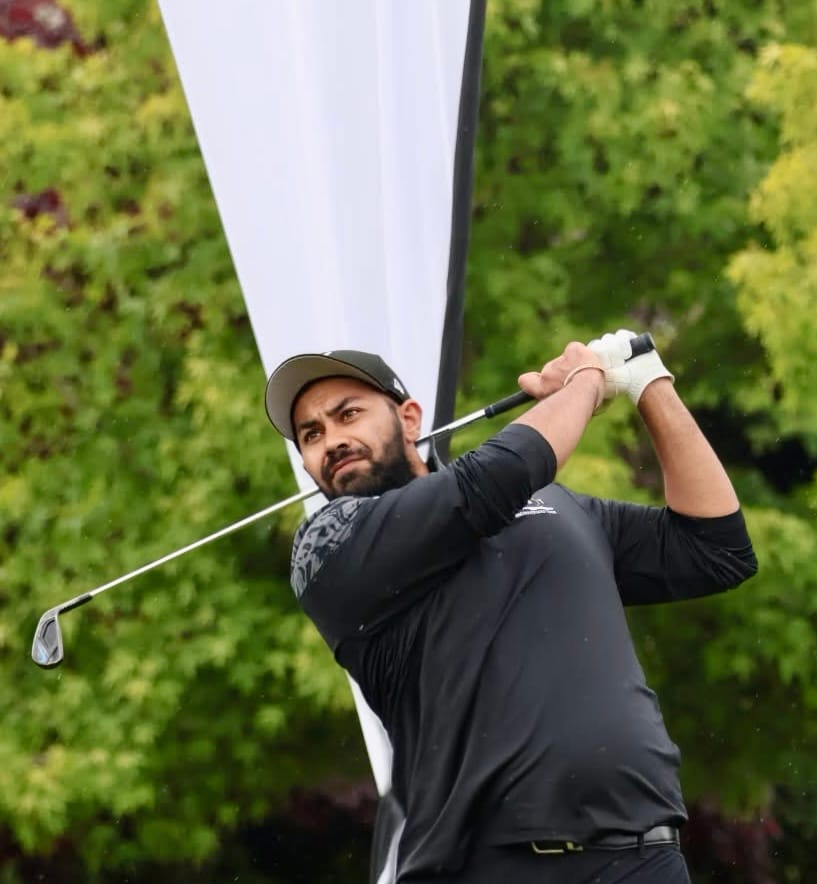
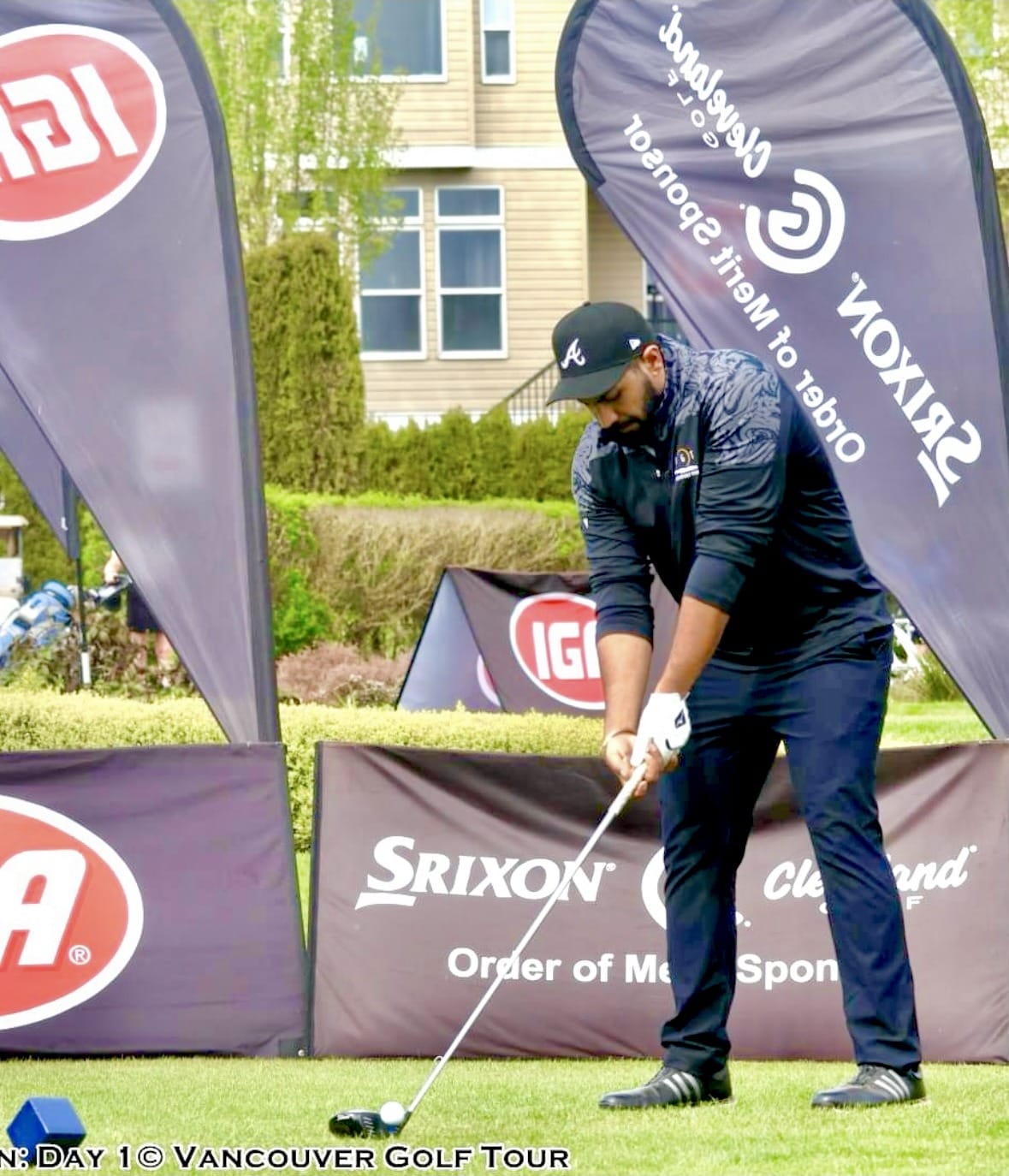
Tarun Chadha addressing the ball on the tee at the Vancouver Golf Tour season opener Day 1 · Vancouver Golf Tour
Debut
Fri, Aug 28
Event
Odlum Brown Vancouver Open
Venues
McCleery · Langara · Fraserview
Field
300+ Players, 54 Holes

Unify Consulting and Coala Studio Inc. have partnered with Vancouver professional golfer Tarun Chadha in a front-of-shirt sponsorship that will carry both companies through his 2026 Vancouver Golf Tour season.

Chadha will wear the marks for the first time on Friday, August 28, when the Odlum Brown Vancouver Open & Fundraising Pro-Am gets underway at Vancouver’s three city courses. It will be his second start as a professional. He turned pro in July after four seasons competing on the Vancouver Golf Tour as an amateur, and made his professional debut later that month at the Cultus Open at Cultus Lake Golf Club.The agreement brings together two Lower Mainland businesses behind a local athlete at a point in his career where support is hardest to find and matters most.

A 54-hole test on Vancouver’s city courses

The Odlum Brown Vancouver Open, presented by Maui Jim Canada and Vancouver Parks Golf, runs Friday through Sunday, August 28–30. Players open with rounds at McCleery and Langara before the final round at Fraserview.The championship is open to male and female professionals along with amateurs carrying a handicap index of 26.0 or lower, and recent editions have drawn fields of more than 300 players. It carries World Amateur Golf Ranking points as well as points toward the 2026 Srixon/Cleveland Order of Merit and Race to Wailea on the Vancouver Golf Tour. Jeevan Sihota won the 2025 title at 18-under par, tying the tournament scoring record.The Vancouver Golf Tour has operated since 2006 under the mission of “preparing tomorrow’s champions,” giving B.C. players a place to build tournament experience without the cost of travelling to do it. This year marks its 20th season.

Chadha on turning pro

Competitive golf has been part of Chadha’s life since his junior years, and the last four have been spent on the VGT.
“I’ve seen a lot of ups and downs. I played as an amateur until last month, when I decided to turn pro. I felt my game was in a great spot to be able to compete with the top professionals on tour.”Tarun Chadha
He describes the pull of the game in terms of learning rather than results.
“I’m all about learning and educating myself as much as I can about the game. Going from watching some great players to competing against them is a great feeling. That’s when all the countless hours of practicing seem worth it.”Tarun Chadha
On the partnership itself, Chadha said having both companies behind him gives him confidence heading into the tournament, and that representing them well is part of what motivates him to compete. Asked about his mindset for the week, he pointed away from the leaderboard entirely — his focus, he said, is on trusting his process and competing with confidence from the first tee shot to the last putt.

Why Unify got involved

For Jimmy Hansra, Principal Consultant at Unify Consulting, the decision was personal. Hansra captained Canada’s national cricket team and represented the country in one-day and T20 internationals between 2010 and 2014, all while building a career as a professional engineer and project manager.
“I played cricket for Canada, and I know what it takes to compete at the highest level in this country. For most athletes here, the game does not pay the bills. People in the community stepped up to support me along the way, and I have never forgotten that.”Jimmy Hansra, Principal Consultant, Unify Consulting
Hansra added that Chadha is competing with a discipline and patience most people never see — the same character Unify values — and that backing him is his way of passing on what was once given to him.

Why Coala Studio got involved

For Coala Studio founder Rounak Sardesai, the connection goes back further than the agency does.
“Tarun introduced me to golf. He took me out to a range years ago and I’ve played ever since. When the agency side of things gets busy, the course is usually where I end up.”Rounak Sardesai, Founder, Coala Studio
Coala Studio spends most of its time building sponsorship and athlete partnership strategy for other brands. This one, Sardesai said, it built for itself.
“We’re constantly helping clients find the right people to put their name behind. At some point you have to ask why you aren’t doing it yourself. This isn’t a campaign for us. It’s a local business getting behind someone from our own community who has earned it.”Rounak Sardesai, Founder, Coala Studio
In Their Words

“Knowing that I have the support of people and businesses in our community gives me even more motivation to go out there, compete hard, and represent them the best way I can.”

Tarun ChadhaProfessional Golfer

“Tarun is a young professional competing with discipline and patience that most people never see. That is the same character we value at Unify.”

Jimmy HansraPrincipal Consultant, Unify Consulting

About Tarun Chadha Athlete

Tarun Chadha is a Vancouver-based professional golfer. He competed on the Vancouver Golf Tour as an amateur for four seasons before turning professional in July 2026, making his pro debut at the Cultus Open. The Odlum Brown Vancouver Open is his second professional start.

About Unify Consulting Sponsor

Unify Consulting provides strategic guidance across real estate portfolios, with expertise spanning engineering, project management, and land development. The firm is led by Principal Consultant Jimmy Hansra, P.Eng., PMP, a former captain of Canada’s national cricket team.unifyconsulting.ca →

About Coala Studio Sponsor & Publisher

Coala Studio is a sports marketing agency based in the Lower Mainland. The team works with sports brands, clubs, academies, and athletes on sponsorship strategy, athlete partnerships, campaign creative, and the digital systems that sit behind them — turning a logo on a shirt into attention that can actually be measured.coalastudio.ca →
Categories
News

What EA Sports Teaches eCommerce About Retention

In the world of gaming, EA Sports has become synonymous with recurring revenue and customer retention. Their revenue model, particularly through games like FC 24, is a masterclass in keeping customers engaged and spending year after year. For eCommerce businesses, there’s a lot to learn from EA Sports’ approach.

Building an ecommerce business is not just about attracting new customers. The real challenge is keeping them coming back. While many brands spend heavily on advertising, companies like EA Sports generate billions by encouraging repeat engagement and recurring purchases. Fortunately, ecommerce businesses can apply many of the same customer retention principles.


In this guide, you’ll learn how EA Sports’ revenue model works, why customer retention matters more than constant acquisition, and how to build recurring revenue for your own ecommerce business.

What EA Sports Teaches eCommerce About Retention

The secret to eCommerce retention

In the world of gaming, EA Sports has become synonymous with recurring revenue and customer retention. Their revenue model, particularly through games like FC 24, is a masterclass in keeping customers engaged and spending year after year. For eCommerce businesses, there’s a lot to learn from EA Sports’ approach. 


By applying similar strategies, you can build stronger customer relationships. As a result, you’ll increase repeat purchases, improve loyalty, and create sustainable growth.

The Importance of Recurring Revenue in eCommerce

Every successful ecommerce business eventually reaches the same conclusion: retaining customers costs less than constantly finding new ones. Therefore, recurring revenue becomes one of the most valuable growth strategies.

Some of its biggest benefits include:

– Predictability: Recurring revenue allows you to forecast income more accurately, which is crucial for budgeting and planning.
– Customer Lifetime Value (CLV): By encouraging repeat purchases, you increase the lifetime value of each customer, maximizing the return on your initial customer acquisition costs. – Business Stability: With a steady stream of recurring revenue, your business is less susceptible to the ups and downs of seasonal sales or market fluctuations.
– However, customer loyalty is the foundation of any successful recurring revenue model. EA Sports has mastered this by understanding what keeps their audience hooked. Here are some strategies you can apply to your eCommerce business:
– Personalization : Tailor your offerings to meet the specific needs and preferences of your customers. Personalization can be achieved through product recommendations, targeted email campaigns, and exclusive offers.
– Engagement : Likewise, regular communication keeps your brand top of mind. Newsletters, loyalty rewards, social media updates, and educational content all strengthen long-term relationships.
– Exclusive Access:  Finally, exclusive products, early access sales, and VIP memberships create a sense of belonging. Customers appreciate feeling valued, which encourages repeat purchases.
For eCommerce businesses, creating a recurring revenue model involves not just offering a great product but also providing ongoing value that keeps customers coming back. EA Sports does this through regular game updates, special in-game events, and exclusive content, all of which encourage players to stay engaged and spend money over time.
Just as EA Sports releases new content and updates to keep players engaged, your eCommerce business should focus on delivering consistent value to your customers, whether it’s through new product releases, improved services, or exclusive offers.
Furthermore Subscription and membership programs make repeat buying simple. Meanwhile, businesses enjoy predictable monthly revenue and stronger customer relationships. When customers receive ongoing value, they are far more likely to stay engaged over time.

Elysian Coffee’s Successful Subscription Model

One of our clients, Elysian Coffee, provides a prime example of how to successfully implement a subscription model in eCommerce. Elysian Coffee offers high-quality, ethically sourced coffee through a subscription service that delivers fresh beans to customers’ doors every month.

Elysian Coffee’s Successful Subscription Model

We partnered with Elysian Coffee to build their Shopify store and implement their subscription model. The result? An outstanding online experience that not only showcases their premium product but also makes it easy for customers to sign up for a subscription. Thanks to their commitment to quality and our strategic implementation, Elysian Coffee enjoys an impressive 90% returning customer rate.


This success demonstrates the power of a well-executed subscription model in driving customer retention and recurring revenue.


Customer retention is not about encouraging a single purchase. Instead, it’s about building lasting relationships that generate value over time. Ultimately, businesses that focus on recurring revenue grow more sustainably than those relying only on new customer acquisition.
Contact Coala Studio today to discuss your EA Sports Teaches eCommerce About Retention.
Categories
News

How to Choose a Web Design Agency (2026 Guide)

Choosing a partner to build your website should not feel like swiping right on a stranger.
However, many businesses make decisions based only on attractive portfolios and bold promises.

Instead, focus on measurable outcomes. A great website should load quickly, rank well, and generate leads.


Ultimately, you’re investing in a business asset—not just a beautiful design.


Why your website matters more than ever

People decide whether to trust you in seconds. If your site feels dated, confusing, or slow, they leave. A great web design agency will build a website that captures this. It loads instantly, looks current, and guides you through a clear story. Your site should do the same for your customers.


It must communicate who you are, what you offer, and why it matters, then make the next step effortless. When you think about how to choose a web design agency, start with this baseline. You are hiring a team to create a high-performing asset that supports sales every single day.


What a real web design agency actually does?

Design is only one piece. The right team blends strategy, user experience, copy, development, SEO, analytics, and conversion thinking. They plan the information architecture, map out journeys, design interfaces, write or guide the content, build clean code, optimize for search, and measure what matters after launch.


When you review any web design agency’s website, look for signs of this full stack approach. Case studies should show the challenge, the process, and the result, not just screenshots.


Start With Your Business Goals

Clarity saves you time and money. Decide whether you need a brand new build or a redesign. Define the job your site must do. Is it a lead machine, an online shop, a booking system, or a credibility play that supports sales calls.


List the essentials you cannot live without and set a realistic budget. When you lead with outcomes, you attract partners who think like builders, not decorators. That is the heart of how to choose a web design agency that fits.
Judge them by their own website You should feel the quality of their thinking the moment their page loads.


If a web design agency’s website is slow, confusing, or looks like it belongs in your high school computer lab, that is your sign. You should know what they do within five seconds, and you should be able to find examples of work without hunting. If they cannot sell themselves clearly, they will not sell you clearly either.

Ask for a defined process. Professionals don’t wing it.


Invite them to walk you through their approach, from discovery and strategy to wireframes, visual design, content planning, development, testing, launch, and maintenance. You’re listening for structure and clear checkpoints. The best teams share drafts early, test assumptions, and protect timelines with ruthless clarity. If they skip testing or treat SEO as an afterthought, keep looking. A strong, transparent process is the backbone of choosing a web design agency built for lasting success.

Make UX, SEO, and CRO non-negotiable A site that looks amazing but does not rank or convert is expensive wall art. Ask how they approach technical SEO, on-page structure, site speed, and accessibility. Ask how they design for mobile and touch interactions. Ask how they plan to turn visitors into buyers or booked calls. You are not being fussy. You are protecting revenue. Any team serious about outcomes will light up when you ask these questions. This is the smartest filter in when choosing a web design agency that designs for humans and search engines at the same time.

Watch how they communicate You will spend weeks together.


Pay attention to how they show up before you sign.

  • – Do they respond quickly?
  • – Do they ask sharp questions?
  • – Do they translate technical choices into plain language?
  • – Strong communication during meetings usually means strong communication during production.
  • – Flaky now means flaky later. Consistent now means consistent when you need them most.
  • – Who will manage my project?
  • – Will I own the website?
  • – Is SEO included?
  • – Will the site meet Core Web Vitals?
  • – What happens after launch?
  • – Do you provide training?
  • – Which CMS do you recommend?
  • – How do you measure success?


Be transparent about budget and ownership


Money should be clear and straightforward. You should know what is included, what is out of scope, and how changes are handled.

You should also own your domain, your code, your content, your CMS, and your analytics. If a firm wants to keep control of logins or license core pieces to you, do not agree.

A key step in how to choose a web design agency is making sure you will not be held hostage after launch.


Proactivity and motivation separate the great from the good

Here is the trait most teams forget to market.


The best partners are proactive. They take notes you did not ask them to take, send recaps you did not know you needed, and raise risks before those risks cost you time. They test variations, read analytics, and adjust based on data. When a blocker appears, they come with options, not excuses. If you want the shortcut version of how to choose a web design agency, choose the team that behaves like an extension of your company from the first call. Curiosity, initiative, and follow-through are not soft skills. They are the reason projects cross the finish line cleanly.


Red flags you should not ignore Vague pricing is a problem. So is a fuzzy process. If they dodge questions about who will be working on your project, if timelines sound like guesses, or if you cannot get a straight answer about SEO, trust your instincts. Reviews and case studies help, but your gut is allowed to vote. The human fit matters because this is not a transaction. It is a partnership.


How Coala Studio approaches the work We build sites to perform. Strategy first, then design that people actually use, then development that is fast and flexible, then measurement that tells the truth. When we say we know how to choose a web design agency, it is because we have been the agency chosen by teams who were burned before. We take the time to understand your customers, your sales cycle, and your goals. Then we ship a site that earns its keep


Final word There is no magic trick in how to choose a web design agency. It takes clarity about outcomes, discipline in process, and honesty in communication. Start with your goals, evaluate their own website, ask for a real plan, confirm they cover UX, SEO, and CRO, protect your ownership, and choose the people who act like partners before a contract is signed. Do this and your site will do more than look good—it will sell, rank, and grow with you. If you want a website that proves all of the above, talk to us. We will show you how your next site can stop being a cost center and start being the best salesperson on your team.


Key Takeaways

  • Define your business goals first.
  • Review the agency’s portfolio and process.
  • Make SEO, UX, and CRO mandatory.
  • Confirm ownership of your website assets.
  • Choose a proactive long-term partner.


Frequently Asked Questions

How do I choose the right web design agency?

Start by defining your business goals, budget, and timeline. Then, review each agency’s portfolio, client testimonials, and case studies to evaluate their experience. Ask about their design process, SEO knowledge, communication style, and post-launch support. The right web design agency should focus on creating a website that not only looks professional but also supports your business growth and delivers measurable results.


What should I look for in a web design agency?

Look for an agency with a strong portfolio, proven experience, transparent pricing, and positive client reviews. They should offer responsive web design, SEO best practices, fast-loading websites, and ongoing support. A reliable agency will also take the time to understand your business, target audience, and long-term goals before starting the project.


How much does it cost to hire a web design agency?

The cost of hiring a web design agency depends on the size and complexity of your project. A basic business website typically costs less than a custom website with advanced features, integrations, or ecommerce functionality. Instead of choosing the cheapest option, focus on the value the agency provides, including strategy, design quality, SEO, performance, and long-term support.


How long does it take to build a website?

Most professional websites take between four and twelve weeks to complete, depending on the project’s scope. Simple websites can be completed more quickly, while custom websites with advanced functionality, ecommerce features, or extensive content require additional time. Clear communication and timely feedback from both the client and the agency help keep the project on schedule.


Does a web design agency include SEO services?

Some web design agencies include basic SEO as part of their website development process, while others offer it as an additional service. At a minimum, your website should include SEO-friendly page structure, optimized images, mobile responsiveness, fast loading speeds, and proper metadata. If search engine visibility is important for your business, ask the agency exactly what SEO services are included before the project begins.


Should I hire a freelancer or a web design agency?

A freelancer can be a good choice for small, straightforward projects with limited budgets. However, a web design agency is often better suited for businesses that need a complete solution, including strategy, design, development, SEO, content, and ongoing support. Agencies also provide access to a team of specialists, making it easier to handle complex projects and future growth.


Why is responsive web design important?

Responsive web design ensures your website works smoothly on desktops, tablets, and smartphones. It improves the user experience, reduces bounce rates, and helps your site rank better in search engine results. Since most users now browse on mobile devices, a responsive website is essential for attracting visitors and increasing conversions.


What questions should I ask before hiring a web design agency?

Before hiring a web design agency, ask about their experience, design process, project timeline, pricing, SEO approach, and post-launch support. You should also confirm who owns the website after launch, whether content management training is included, and how they measure project success. These questions help you choose a reliable partner that aligns with your business goals.


Contact Coala Studio today to discuss your strategy.

Categories
News

Branding vs. Website Design: What’s the Difference?

Most people think a logo and a website are all it takes to build a brand. They hire a designer, launch a shiny new site, and wait for magic to happen. But here’s the truth: branding and website design are not the same thing, and treating them like they are is one of the most common reasons businesses fail to connect, convert, or grow online. To build something that actually works, you need both – a brand that defines who you are and a website that brings that story to life in pixels and performance. Let’s break it all down, starting with why people get confused, and how to get it right


Businesses today compete online long before customers speak to a salesperson. Your brand creates the first emotional impression, while your website delivers the practical experience that influences purchasing decisions. Search engines also reward websites that provide clear messaging, excellent user experience, fast performance, and trustworthy content. When website branding strategy works, businesses enjoy stronger recognition, better engagement, higher search visibility, and improved conversion rates. That is why understanding the relationship between branding and website design is essential for sustainable digital growth.


Why People Confuse Branding and Website Design

Brand identity design often blur together because both deal with how your business looks and feels online. You can’t build a site without some sort of logo or color palette, and you can’t develop a brand identity without seeing how it will live on the web. But they serve two very different purposes.


First, Branding shapes perception. It is the strategy, emotion, and storytelling behind your business. Meanwhile,  website design is the execution, the visuals, layout, and user experience that deliver your brand’s message to real people. Understanding the difference between branding and website design is the first step toward creating something cohesive and high-performing. If your brand defines your personality, your website is how you shake hands with the world.


What Is Branding?

Branding isn’t a logo. It is what people think and feel when they interact with your business. It is the emotional connection that keeps them coming back, the perception, promise, and experience that make your company memorable.


The Core Components of Branding A strong brand starts with clarity. That means having a vision and values that drive your actions, a voice and personality that guide how you communicate, and a unique value proposition that separates you from everyone else. It is also about storytelling, how you frame your mission, talk about your customers’ problems, and show the transformation your product or service delivers.


Then comes the visual identity: your logo, color palette, typography, imagery, and design system. Your visual branding should express your strategy, not just decorate it. For example, if you are a low-sugar, allergy-conscious brand for kids, parents should feel confident packing your soda for lunch every day. That means your brand can be fun, bubbly, and full of color, rather than dark, edgy, or mysterious. The visuals are important, but they should never exist without strategy behind them.


Finally, great brands stay consistent. Every touchpoint, from packaging to website to email signature, should reinforce the same message and feeling. That consistency builds trust, recognition, and loyalty over time. Think of Apple, Nike, or Patagonia. Each one makes you feel something specific: innovation, empowerment, authenticity. Their logos are simple, but their meaning runs deep because everything they do, from visuals to tone to user experience, reflects the same values. That’s user experience design working in perfect sync.


What Is Website Design?


If branding defines who you are, website design defines how people experience you. It is the craft of turning brand strategy into an interactive digital space that communicates, converts, and performs.


The Core Elements of Website Design Website design involves the information architecture, how your content is structured and how users move through it. It includes the layout, navigation, copy, and imagery that make your site intuitive and appealing. It is also about interaction: how buttons behave, how transitions feel, and how the design responds across devices. A well-built site feels effortless, even though a lot of strategy and engineering go into making it that way.


Additionally, Beyond aesthetics, a great website design also accounts for accessibility, mobile responsiveness, and performance. It is optimized for search engines (SEO), built for conversion (CRO), and refined through data and analytics.


How Website Design Brings Branding to Life Your website should look and feel like your brand, with the same colors, tone, and energy that people associate with your business. Think about McDonald’s: no matter where you are in the world, the golden arches, the red and yellow palette, and the simple layouts are instantly familiar. That’s how consistent branding and website design work together.


Branding vs. Website Design: Key Differences

Let’s make this simple. Branding is the strategy that defines what your business stands for and how it’s perceived. Website design is how that strategy looks, feels, and functions online.


– Purpose: Branding builds emotional connection and identity, while website design focuses on usability and conversions.

– Timeframe: Branding is long-term and foundational, while website design evolves as technology and content change.

– Output: Branding delivers a message and reputation, while website design delivers a tangible, interactive experience.

– Metrics: Branding success is measured in recognition and loyalty, while website design success is measured in traffic, engagement, and conversions. You can’t have one without the other.


Branding and website design are two halves of the same strategy. Branding gives your website meaning. Website design gives your brand momentum.


How Branding and Website Design Work Together

Furthermore, here’s where things get powerful. Branding informs every design decision, from tone of voice and visuals to how your navigation is structured. When your brand identity design align, your message becomes consistent across every channel. That consistency builds trust and improves performance. Strong branding makes design choices easier.


A designer who knows your voice and audience can create layouts, calls to action, and content structures that feel authentic. And because your audience recognizes the same visual cues from social media, packaging, and advertising, your credibility compounds.  However, poor branding makes design harder.If your messaging is unclear or your values are inconsistent, no amount of web design can fix that.


The Collaboration Loop: Strategy → Design → Test → Iterate


At Coala Studio, this is how we work. We do not just design; we build systems that evolve. Every project moves through a cycle: strategy, design, test, and iterate to make sure your brand and website stay in sync. It starts with strategy. We dig into your goals, audience, and positioning before touching a single layout. Then comes design, where your story turns into visuals, words, and experiences that connect.


Once the site is live, we test every detail: load speed, accessibility, and how users actually move through the site. Finally, we iterate. We refine the copy, test different calls to action, and tweak user flows based on data. That is how we turn a good website into a high-performing one. It is not a one-time project. It is a living process that grows with your business.


Why Your Business Needs Both Branding and Website Design


Ultimately, conversion-focused website define your identity and deliver it. You need both for real impact. Branding builds emotion and recognition. Website design translates that emotion into interaction, usability, and measurable growth. If you take one thing from this, let it be this: never design before you define. Build your strategy first, then design your experience.


That’s the difference between a site that exists and a site that converts. At Coala Studio, we do both – strategy and execution. We create brands that people remember and websites that people use. If you’re ready to bring your business to life with cohesive digital brand experience, start here. Because when your brand and your website speak the same language, everything clicks.


Frequently Asked Questions


What is the difference between branding and website design?

Branding defines your business identity, values, personality, and messaging, while website design creates the digital experience that presents your brand online. Branding shapes perception, whereas website design focuses on usability, functionality, and conversions. Together, they create a consistent and memorable customer experience.


Can I build a website before creating my brand?

You can, but it is not recommended. A website built without a clear brand strategy often lacks consistency in messaging, visuals, and user experience. Defining your brand first ensures every design decision supports your business goals and resonates with your target audience.


How does branding improve website SEO?

Strong branding improves user trust, increases branded searches, encourages longer visit durations, and supports consistent messaging across your website. These factors can positively influence engagement metrics, which contribute to stronger overall SEO performance alongside technical optimization.


Why should branding and website design be done together?

When branding and website design are developed together, your visual identity, messaging, and user experience remain consistent across every touchpoint. This creates a more professional online presence, builds customer confidence, and improves conversion rates.


How often should a business update its branding or website?

Most businesses should review their branding every 5–10 years or when their market positioning changes. Websites should be evaluated more frequently, with regular updates for content, security, SEO, and user experience to keep them competitive and aligned with business goals.


Need help aligning your brand with a high-performing website? Coala Studio combines brand strategy, UX design, SEO, and development to create websites that not only look exceptional but also generate measurable business growth.